
Introduction
Oil is the most needed commodity or resource for any nation. However, in the last few years, oil has been at the center of the conflicts. It has resulted in price discrepancies and insecurities among nations with high crude oil demand. However, it doesn’t mean that oil is running out in the world. In fact, many oil reserves show great potential. Let’s look at the biggest oil reserves and what role they play in the future!
How the Biggest Oil Reserves Are Measured
Oil reserves are tracked by the OPEC and EIA statistical review. They work on the data provided by SPE. The measurement is based on barrels of oil that can be extracted using the present technology. The complicated procedure gives an estimation of the crude oil in a region. However, the statistics can vary based on geopolitical and extraction processes in the region.
The Top 10 Countries with the Largest Oil Reserves
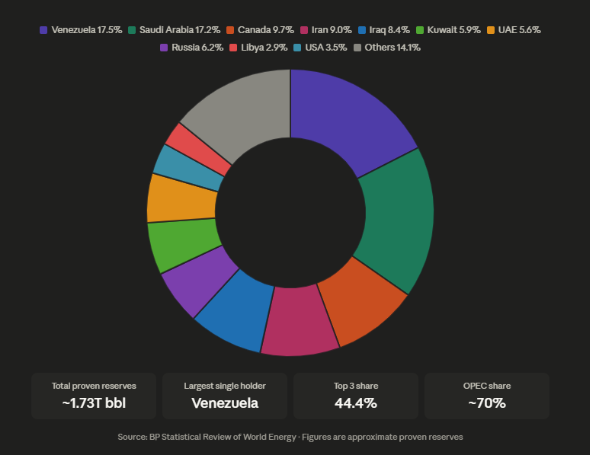
Some countries are favoured with oil, while others are entirely dependent on imports. Here are the top countries with the biggest oil reserves in 2026.
- Venezuela
- Saudi Arabia
- Canada
- Iran
- Iraq
- Kuwait,
- UAE,
- Russia,
- Libya &
- United States
The list is based on the reserve’s quantity. However, the extraction capabilities of each nation are different.
The Difference Between Reserves and Production
The largest reserve does not mean it has the most production. For instance, Venezuela has the highest reserve, but it is not efficient in extraction. The top extractors are from the Middle East, even though their capabilities have been impacted by the US-Iran war in 2026.
Therefore, for more efficient measurement, it is best to measure the ratio of reserve-to-production metrics. The rate of extraction depends on the latest equipment as well. In that case, the USA takes the lead in technology for crude oil extraction.
Geopolitics of Oil Reserves
OPEC has control over global supply and pricing. All the Middle Eastern countries are mostly transparent with their supply since they need imports as well. However, the alliances based on oil trade can be easily disputed with the foreign policies of non-participating nations. This is the reason why we have seen instability in the region.
The Role of Technology in Unlocking Reserves
Technology plays a crucial role in extracting quality crude oil at efficient rates. The enhanced oil recovery techniques employed in 2026 are better than those of the past. Moreover, the new technologies also give us the opportunity to explore deep-water reserves and continue shale oil exploration.
Environmental and Ethical Aspects of Oil Extraction
Crude is not only a resource but the backbone of human civilization. To this day, we are not capable of developing energy resources that can replace oil. But it doesn’t mean we ignore the harmful aspects of oil, like the carbon emissions.
The harmful gases emitted by burning oil lead to climate change. That is why it is necessary for us to move towards renewable energy. It will take time, but we have to start from somewhere. Alternatives like solar and nuclear energy can be the future of a post-carbon world.
The Future of Global Oil Reserves
Crude oil will be available in the future. It is the energy of all human operations in the present. However, this makes it a center of conflicts and geopolitical differences. The nation that controls oil will have control over the world. Moreover, new countries are also emerging with oil reserves. Even considering the high consumption rates of the world, oil might last over the coming decades.
Final Thoughts on the Biggest Oil Reserves
Oil remains crucial for global civilization, with significant reserves still available despite conflicts impacting prices and security. The quantity of reserves does not equate to production efficiency, as seen with Venezuela’s large reserves but low extraction capability.
Technology plays a vital role in enhancing extraction processes, especially with advances in deep-water and shale oil exploration. While oil will continue to power human operations, it remains a focal point of geopolitical conflicts, and new players are emerging in the global oil landscape.