

Introduction
Artificial Intelligence ceased to be a far-fetched idea of the future, no longer limited to science fiction. It is now a potent instrument that is reforming some of the most intricate and vital spheres of human development. Some of its greatest influences have been seen in medical research and space exploration, two fields that are highly dependent on data, accuracy, forecasting, and technological advancement. So, let’s look at the role of AI in medical research and space exploration.
AI In Medical Research and Space Exploration
AI is accelerating discovery, reducing human constraints, and creating opportunities never before possible. Whereas medicine aims to enhance and prolong human life, space exploration challenges the limits of human knowledge. These two disciplines share the characteristic of producing large volumes of information that human minds cannot handle.
1. AI’s Role in Revolutionising Medical Research
Medical research has never been a time-consuming, resource-intensive process. Treatments, disease knowledge and clinical trials are often years or decades in the process of development. AI is drastically reducing this timeline.
Data Analysis
Healthcare today generates vast amounts of data, patient history, genetic data, x-rays, and clinical trial outcomes. Such complex datasets cannot be processed efficiently by human researchers. However, AI systems can analyse patterns, detect anomalies, and identify correlations at seemingly incredible speeds.
Personalised medicine
With AI, it is possible to customise treatment for each patient based on genetic background, lifestyle, and medical history. Instead of using generalised solutions, healthcare can shift to precision-based approaches.
Clinical Trials and More
Intelligent systems can be used to optimise patient selection, trial monitoring and data interpretation. With the assistance of AI, it is possible to identify appropriate participants, forecast potential risks, and evaluate trial results more effectively.
Healthcare Outcomes Through Predictive Intelligence
In addition to research laboratories, AI is transforming the delivery of healthcare. Predictive analytics enables healthcare professionals to anticipate medical conditions before they escalate.
Information Processing Using AI
AI systems can analyse patient information to predict possible complications, rehospitalisations, or disease progression. This is a proactive method that turns healthcare into preventative care rather than treatment.
- Resource allocation.
- Timely interventions.
- Better disease interpretation.
Efficiency Using AI in Medical Research
Administration, record keeping, appointment scheduling, and resource management can be streamlined automatically, allowing health professionals to spend more time with patients. The decreasing workload is also indirectly related to improved research and clinical outcomes.
The Implication of AI in Space Exploration
Autonomous operation is one of the most important functions of AI in space missions. Spacecraft and rovers may be far from Earth, making real-time human control impractical due to communication delays.
- Navigation.
- Adaptation.
- Decision-making.
For example, planetary researchers use AI to analyse terrain, navigate around obstacles, and select the best exploration routes.
Space Research Using Artificial Intelligence
The telescopes, satellites and probes gather huge amounts of observational data. Artificial intelligence will be able to filter noise and detect patterns and sky observations much faster than otherwise.
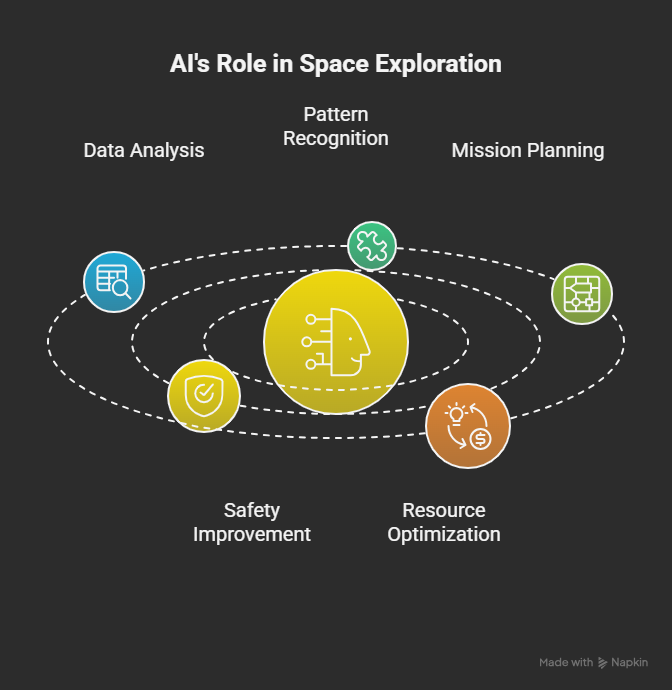
AI is also useful in space mission planning because it is a predictive tool. Smart systems can simulate situations, analyse hazards, and streamline paths. This improves mission safety and minimises resource use.
Challenges and Ethical Considerations
Although AI has a transformative potential, it is also a problem-creator. In medical research, data privacy, algorithmic bias, and transparency in decision-making should be carefully managed. To ensure fairness and accuracy, AI systems need to be trained on diverse datasets.
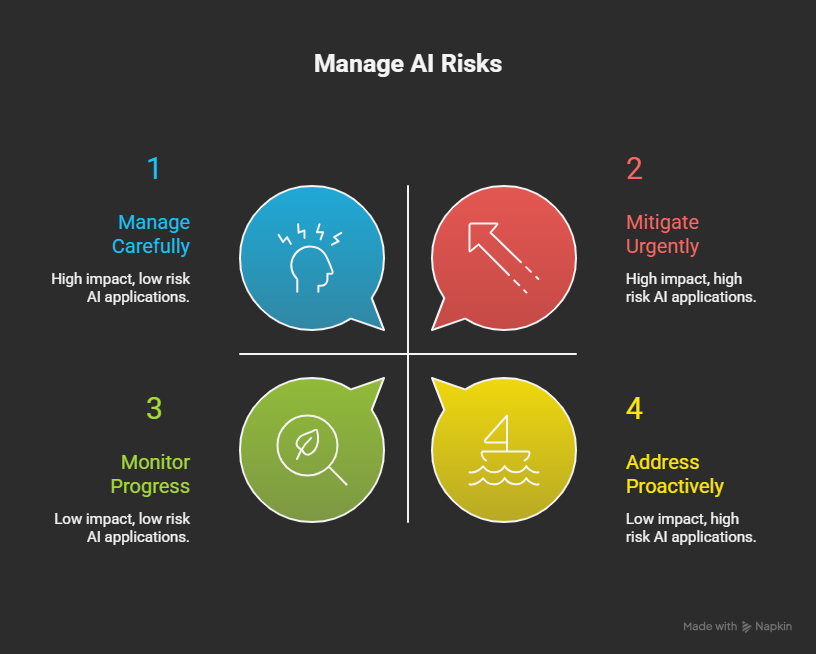
Reliability and safety are the keys to space exploration. Autonomous AI systems should be able to operate in harsh conditions without making mistakes that could be disastrous. Ethical management, regulatory laws, and interdisciplinary cooperation are required to achieve maximum benefits and reduce risks.
Final Thoughts on AI In Medical Research and Space Exploration
AI is essentially transforming the way humans go about the discovery of the inner and outer universe, which are biology and space, respectively. It speeds up the research process, improves accuracy, and opens previously inaccessible opportunities.
With the further development of AI, its impact will increase. The solutions of medical advances can be faster, illnesses can be anticipated sooner, and human knowledge of the universe could increase in leaps and bounds.
We are not merely watching technological advances; we are stepping into another dimension of scientific development, where human intelligence and artificial intelligence collaborate to unlock the deepest secrets of life and the universe.