
Introduction
Writing your first novel can be confusing, but anyone can do it with the right approach. Here we go with some of the tips from successful authors, including idea generation, discipline, structure, characters, and editing, to give future writers the courage to start writing their stories.
How to Write Your First Novel?
Your very first novel is all about your endless thoughts, ideas, and expression of your feelings. Most hopeful writers face the dilemma of not knowing where to start, how to stay motivated, or whether their ideas are good enough.
Novel Writing Tips and More
The fact is that all prosperous novelists were once in the same doubts. A novel is not just a subject of talent but of a thinker, discipline, and knowledge of the art. Using tips from successful authors can be your ultimate guide to writing your first novel.
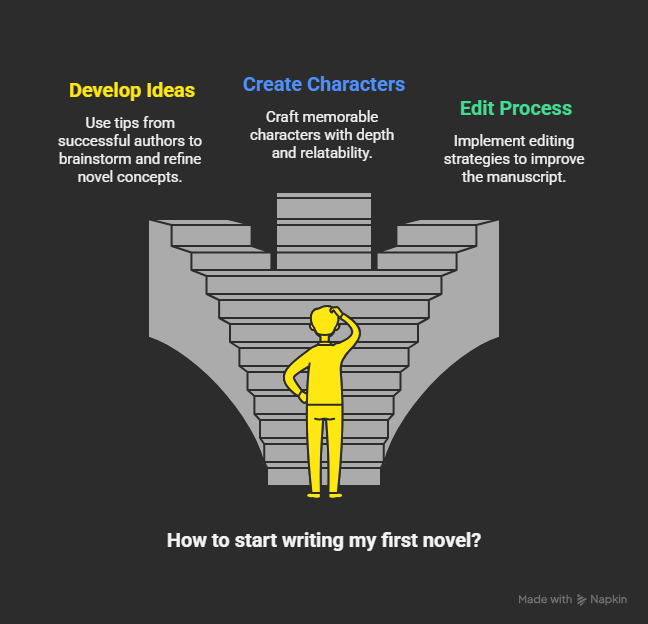
This process comes with some general rules that can prevent most mistakes and help build confidence early. We have listed some of the novel writing tips for the development of ideas, the creation of memorable characters, and the editing process. So this is your sign to give your first novel a kickstart.
Find an Idea Worth Exploring
All novels start with an idea, and novices have the wrong idea of what constitutes a good idea. Great writers often emphasise curiosity rather than innovation.
It is widely known that Stephen King proposed that ideas are all around us; the problem is that writers need to see them. You should not pursue big ideas, but rather you should ask yourself questions that interest you:
- What would happen when a secret altered the life of a person?
- How should loyalty be put to the test?
- What would a normal man do in extraordinary situations?
Build a Writing Habit (Not Just Inspiration)
The idea that writers wait to be inspired is one of the greatest myths about novel writing. As a matter of fact, novels are constructed by habit. J.K. Rowling composed much of her initial manuscripts at the same time as she managed daily obligations.
Progress is not inspired by passion but by discipline, as writing daily becomes a practice that makes the process more easygoing.
Strategies To Follow:
- Write at the same time daily
- Begin with achievable word goals (300-500 words).
- Remove distractions
- Accept imperfect writing
Start Before You Feel Ready
Perfectionism kills novels more than incompetence. Most amateur writers wait to write when they are not ready, as their thoughts or sentences are not smooth. Ernest Hemingway encouraged authors to write the first draft in a rough form; he knew that clarity would emerge during the revision phase.
Remember:
- First drafts should be disorderly.
- Progress beats perfection
- Momentum builds confidence
Create Characters Readers Care About
The plot is the main draw, and the characters should be super interesting. People, not events, attract readers. Agatha Christie was a master of storytelling through character, though she worked with in-depth mysteries.
To create interesting characters:
- Give them desires
- Introduce flaws
- Establish conflicts
- Show transformation
Ask key questions:
- What do they want?
- What do they fear?
- What stands in their way?
Complex characters drive narrative momentum.
Accept That Writing Feels Difficult
The doubt is difficult to overcome, even for veteran writers. Failure is not difficult; difficulty is an element of the creative process. Bird by Bird emphasises that writers should push forward despite their fears and doubts.
Common beginner challenges:
- Self-doubt
- Writer’s block
- Loss of motivation
- Comparing to others
Solutions:
- Write through resistance
- Reduce pressure
- Separate writing from judging
- Trust the process, as progress often feels uncomfortable
Learn to Write Imperfectly
Novices often go too far and worry about perfection at the sentence level. This slows down development at an extremely low rate. Writing emphasises storytelling over polishing. To get a better mindset, always:
- Draft first, refine later
- Ignore inner critic
- Keep moving forward
- Fix during the editing phase
Overcoming Writer’s Block
Writer’s block is often misunderstood. It usually stems from fear, perfectionism, or fatigue, not lack of ideas.
Practical solutions:
- Write badly on purpose
- Change scenes
- Switch locations
- Lower expectations
- Take short breaks
Final Thoughts on Novel Writing Tips
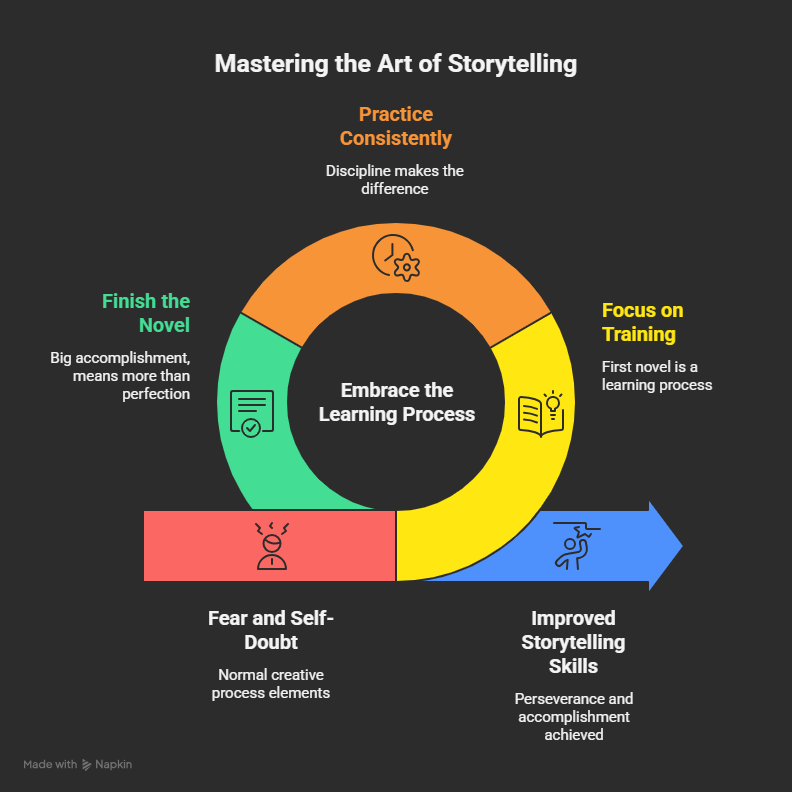
Your first novel must be considered to be a learning process and not a destination. It does not have to be perfect, publishable at once, and revolutionary. Rather, it is your training in the art of telling stories.
All good writers started not knowing anything and having bad drafts. The ability to write is not inspired or born; it is a result of months of work.
It is also worth knowing that fear and self-doubt are normal elements of the creative process, and they hardly fade away even among writers who have been doing it for a long time.
Discipline, or simply the ability to write constantly, be dedicated, and keep going, is what makes the difference between those who achieve and those who cannot.
Most importantly, finishing your novel is a big accomplishment. Ultimately, improvement, perseverance, and accomplishment mean much more than perfection.